
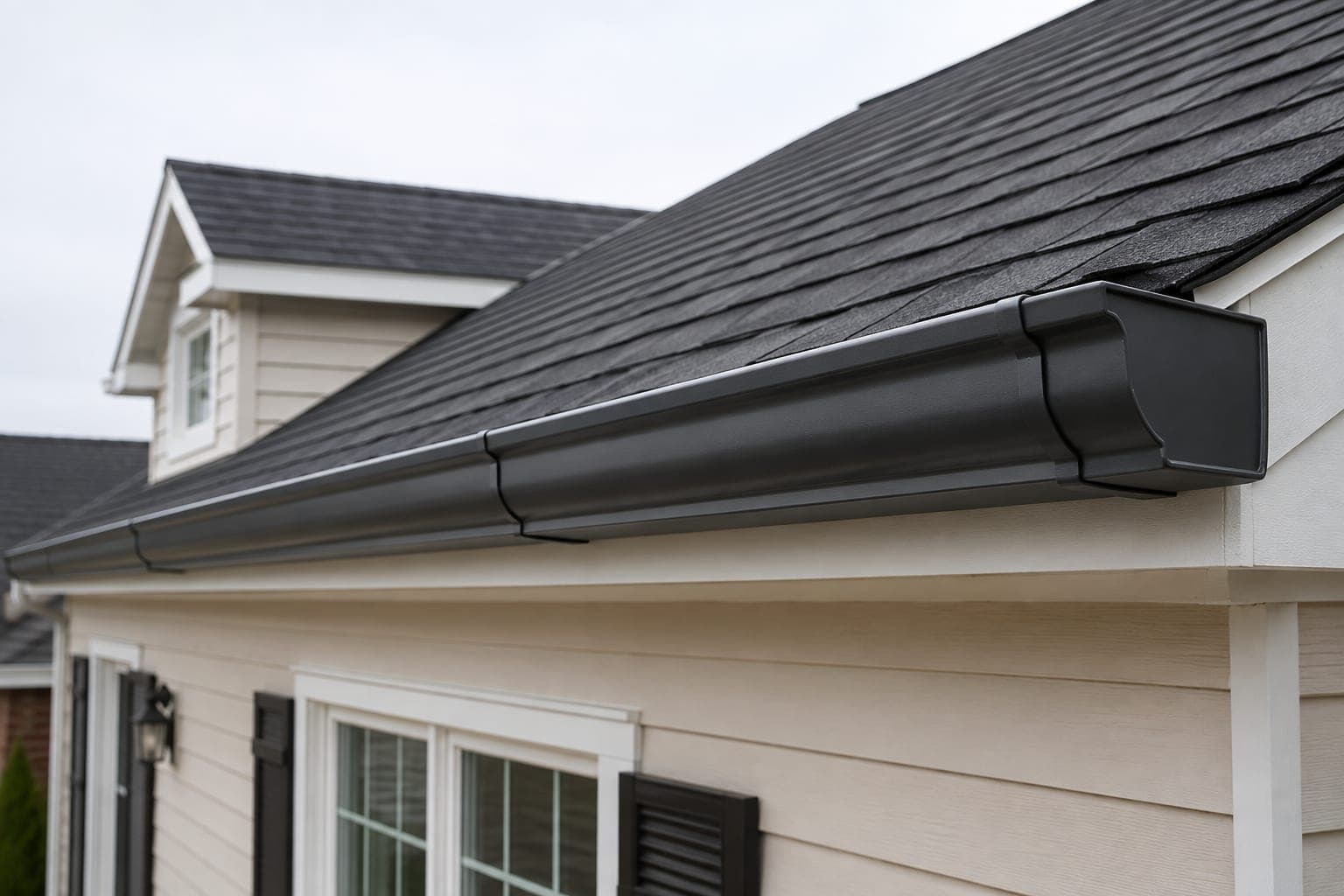
Applications
Aluminum coil for Gutters & Downspouts
Gutters & Downspouts uses seamless rainware. Constant weather exposure, formed on-site; HDPE is the standard choice, PVDF for coastal.
Recommended starting specification
- Coil form
- Seamless rainware
- Recommended coating
- PVDF, HDPE
Guidance, not a fixed datasheet: confirm per order.
Requirements
Gutters sit full of standing water for hours after every rain and cycle wet-to-dry constantly, all while the outward face takes direct UV.
- Runoff chemistry: runoff carries whatever the roof deposits, tannins, mineral residue, and in some climates deicing chemicals, so the coating needs to resist that runoff chemistry as well as sun.
- HDPE vs. PVDF: HDPE is the standard answer for that combination inland; PVDF is worth the upgrade on coastal jobs where salt air adds another line of attack on the coating and the substrate.
Because gutters are formed on-site in one continuous run straight from coil, straightness and flatness matter more here than on shop-formed parts.
- Camber: shows up as a wavy fascia line once the gutter is hung.
- Gauge variation along the coil: makes the portable roll-former's profile inconsistent or jams the machine mid-run, which is a much bigger problem on a ladder than in a shop.
Gauge also has to balance formability against sag: thin enough to feed cleanly through a portable roll-former and handle on a ladder, but thick enough to hold its shape between hangers under a full load of water and debris. Undersized gauge sags between hangers, and a sagging run holds standing water well past any reasonable drainage time, which pits the coating from underneath long before its rated life is up.
How it's formed
Gutter coil is fed through a portable roll-former on-site to produce continuous, jointless lengths cut to the run, while end caps, corners, and outlets are typically formed or stamped separately and joined at installation.
What comes with your order
Material certificates accompany every batch. Test reports and ASTM/EN references are available on request.
Frequently asked questions
- Why is on-site forming different from shop roll-forming for gutter specification?
- On-site forming means the coil itself has to be straight and flat enough for a portable roll-former to run cleanly on a ladder or lift, with no shop-floor adjustment available. Camber or inconsistent gauge that a shop machine could compensate for shows up directly as a wavy fascia line or a jammed run in the field.
- When does gutter coil need PVDF instead of HDPE?
- HDPE is the standard coating for inland gutters and downspouts and holds up well against normal weather and runoff. PVDF is the better choice on coastal jobs, where salt air adds corrosion pressure on top of UV and standing water, both of which PVDF resists longer term.
- What causes gutters to sag between hangers?
- Sag usually comes from gauge that's too thin for the hanger spacing and expected load of water, leaves, and debris. Once a run sags, it holds standing water longer than it should, and that standing water attacks the coating from underneath well before its expected service life.
- How does coil straightness affect a gutter run?
- Camber or coil set in the stock shows up directly as a wavy line once the gutter is formed and hung along a fascia board, since there's no seam or joint to break up the run and hide it. Straighter coil produces a cleaner, tighter line against the fascia.
- What roof runoff factors affect coating choice for gutters?
- Tannins from certain roofing or nearby trees, mineral deposits, and in cold climates deicing salt all pass through the gutter constantly. Those add to the weathering load a coating already carries from UV and standing water, which is part of why HDPE or PVDF, not a lighter PE coating, is the standard spec.